

What is Padel?

Padel it’s a mix between tennis and squash: you have to play the ball over the net and you are allowed to use the walls that surround the court. It’s the fastest growing sport in the world, played by people of all ages and abilities including many famous athletes. It’s simple and fun.

Padel is a sport that is mostly played 2 vs 2 although single courts are available in some clubs. The scoring system is the same as in tennis.

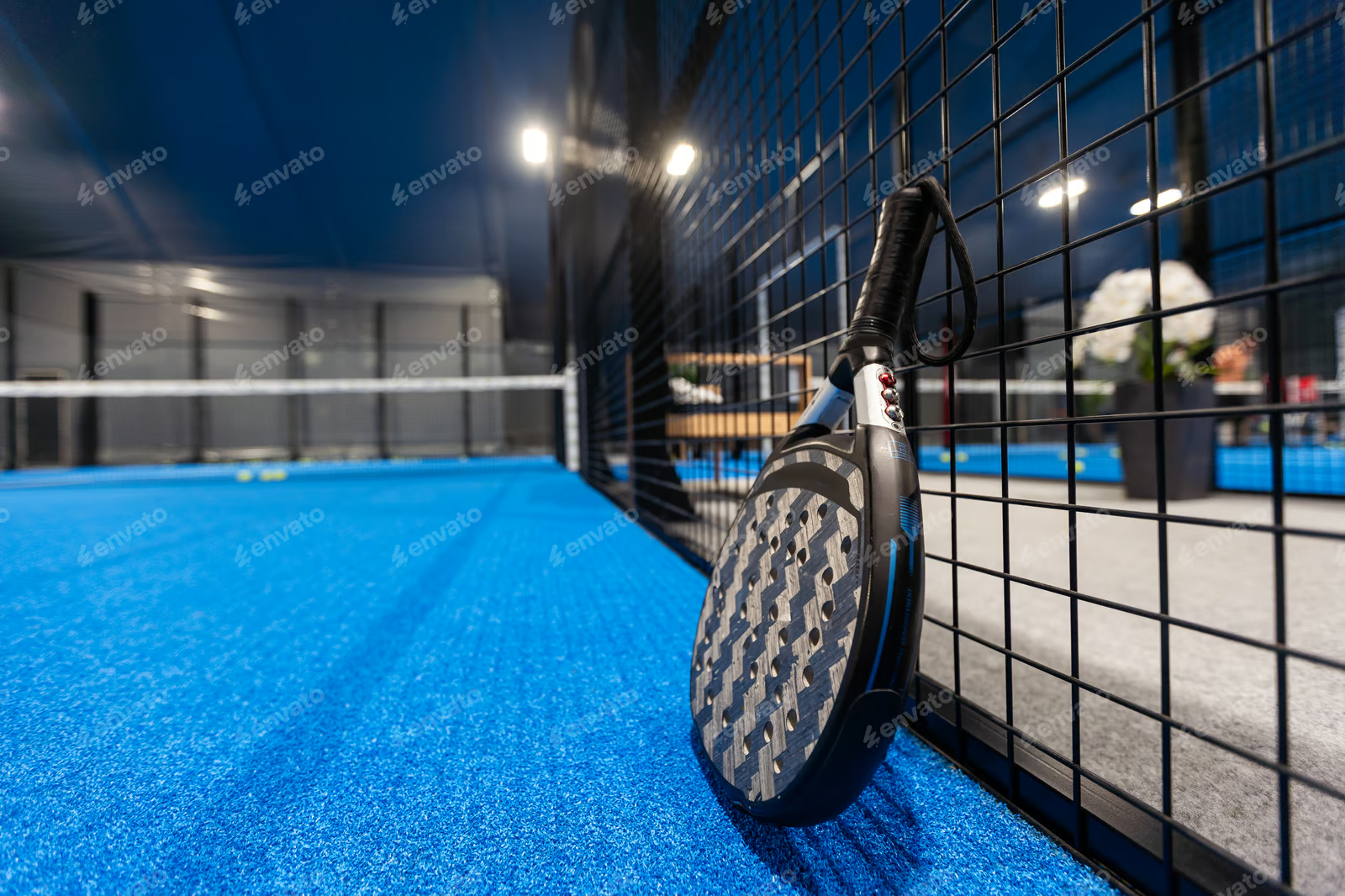
A padel court is 10×20 m, which is smaller than a tennis court, and it’s surrounded by walls and fences with a surface made of artificial grass and sand. The balls used in padel are similar to tennis balls, but softer, and you play with a specific racket that has a hard surface and holes.

EVERYONE can play padel – it’s easy to learn and it’s a sport for all ages and abilities.

History of Padel

The first padel court was created by Enrique Corquera in the late 1960s. He wanted to build a tennis court in his house, but since the space was too limited for a traditional tennis court, he decided to use a small area surrounded by walls and metal fences.

Corcuera invited a Spanish friend, the nobleman Alfonso Hohenloe, to play padel at his home, and he liked it so much that when he returned to Marbella in 1974 he decided to build a padel court in his sports centre, the Marbella Club. It was there that some Argentinian athletes discovered it and decided to import this new game to Argentina, where in just a few years padel became a sport played by millions of people.

Padel was officially recognised in 1991, when the International Padel Federation was established in Madrid.

Padel is one of the most popular sports in Spain today. It is the second biggest sport after football

The first professional padel tournament started in 2005 under the name Padel Pro Tour (PPT).

The Rules

When you hit the ball into the opponent’s court, the ball must first touch the ground, then it can bounce off the glass walls or the fence. Once the ball has touched the glass walls or the fence, the ball can no longer bounce on your ground again, you must hit it back into the opponent’s court.

The ball may hit the back walls several times, as long as it has touched the ground once.

You must not hit the ball back to your opponent’s side until it has passed over the net.

Serving

Each point starts with a serve. The serve in Padel must be underhand and is played diagonally.

The server must bounce the ball once when making a serve and the serve must be made from below waist level.
 
The server must keep at least one foot on the ground when hitting the serve and their feet may not touch or cross the service line while serving.
 
The ball must land inside the opponent’s service area before it is returned. If the ball hits the service area and bounces on the glass walls the serve is good. If the ball hits the service area and bounces on the metal fence the serve is out.
 
As in tennis, the server has a first and second serve.
 
The ball must hit the serve area once before being returned. The returning player can wait for the ball to hit the glass wall before returning, provided it does not hit the ground twice.

Scoring

Soaring in Padel is the same as Tennis (15-30-40-Deuce) and you play the best of 3 sets, 6 games per set.

Instead of playing advantage point, the top players in the world (and many amateur players) instead play “El punto del Oro” or The Golden Point, which is the deciding point in the game. 

In order to win a set you must have a difference of at least 2 games (e.g. 6-4). If the score is 5-5 you play other 2 games to get to 7-5.  If the score is 6-6 you play a 7 points tie-break, similar to tennis.

A point is scored when the ball:

  • hits the glass or fence directly without first bouncing on the ground (the ball is out)
  • it bounces twice on the ground
  • it is hit into the net
  • it is not returned to the opponent’s court (for example it goes out of court after a smash and it is not returned to the opponent’s court)